
Fortinet Network Infrastructure Deployment & Optimization
A complete Fortinet-based network, built around a FortiGate 91G firewall, five FortiSwitches, and five FortiAP access points, deployed for an oilfield company in Abu Dhabi. The project replaced a disorganized cabinet and independently managed devices with a segmented, centrally managed, and fully monitored network.
Overview
Cosmos Innovative Technology Solutions delivered a Fortinet network infrastructure deployment and optimization project for an oilfield company in Abu Dhabi, addressing key challenges around network organization, performance, security, centralized management, and monitoring.
Before the project, the network cabinet and cabling were disorganized, which made identifying connections, troubleshooting, and maintenance difficult. The environment also needed better network performance, security segmentation, centralized device management, and monitoring capabilities.
CITS introduced a complete Fortinet-based infrastructure consisting of a FortiGate 91G firewall, FortiSwitches, and FortiAP wireless access points, with every device integrated through FortiLink so the whole network can be managed from the FortiGate platform. The implementation also covered VLAN segmentation, high-speed 10G uplinks, dedicated wireless networks, guest network isolation, security policies, and FortiAnalyzer Cloud integration.
Following completion, the client’s network is organized, centrally managed, securely segmented, high-performing, and easier to monitor, troubleshoot, and maintain.
Project Objectives
The primary objective was to modernize and optimize the client’s existing network infrastructure by implementing Fortinet solutions that would provide:
Improved network performance
Centralized network management
Enhanced network security
Proper VLAN segmentation
Secure guest wireless access
Improved cable and cabinet organization
High-speed inter-switch connectivity
Centralized logging and monitoring
Simplified troubleshooting and maintenance
Improved scalability for future requirements
The Challenge
Before the implementation, the client faced several network infrastructure challenges that affected day-to-day administration, troubleshooting, security, and network performance.
Disorganized Network Cabinet
The main cabinet and its cabling were not properly organized. Cables were difficult to trace and identify, which increased the time needed for troubleshooting and maintenance.
Network Performance Limitations
The existing infrastructure needed optimization to support higher network speeds and stable connectivity across network endpoints.
Limited Centralized Management
Switches and wireless access points were managed independently, which made network administration more complex.
Segmentation Requirements
User, voice, access point management, and guest networks needed proper segmentation to improve security and traffic control.
Limited Visibility & Monitoring
A centralized monitoring and logging solution was needed to give better visibility into network activity, events, and security-related information.
Network Cabinet: Before and After
One of the major improvements delivered during the project was the complete reorganization of the main network cabinet. The cabinet and its cabling had been disorganized, which made network connections hard to trace and individual network points hard to identify, adding to the effort of troubleshooting and routine maintenance.
- Main network cabinet fully reorganized
- Network cables properly dressed and routed
- Cable management implemented
- Network points and cables clearly labeled
- Network equipment arranged in an organized manner
- Cable identification improved for future troubleshooting
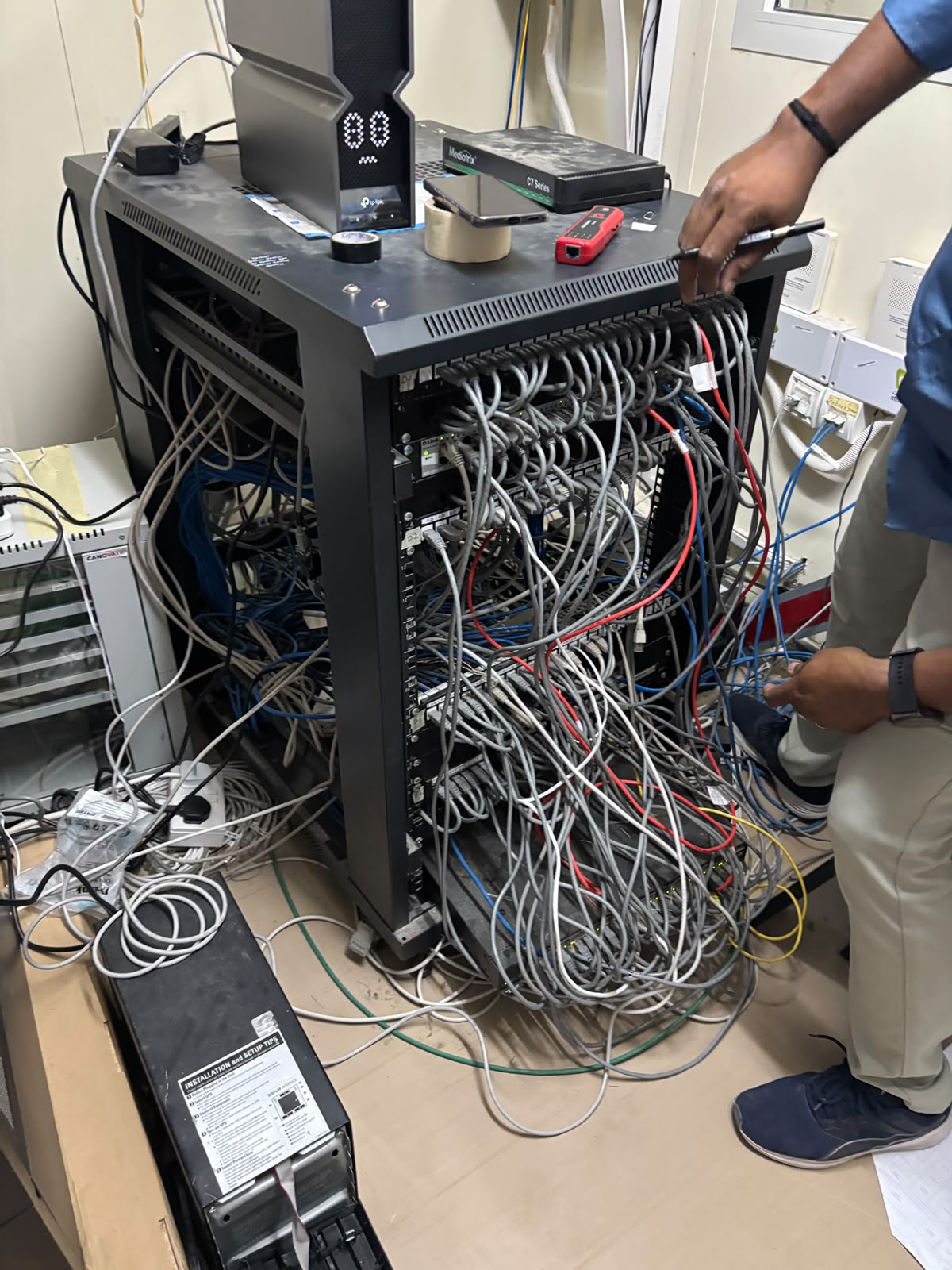 Before
Cables were difficult to trace and identify, which made troubleshooting and maintenance harder than it needed to be.
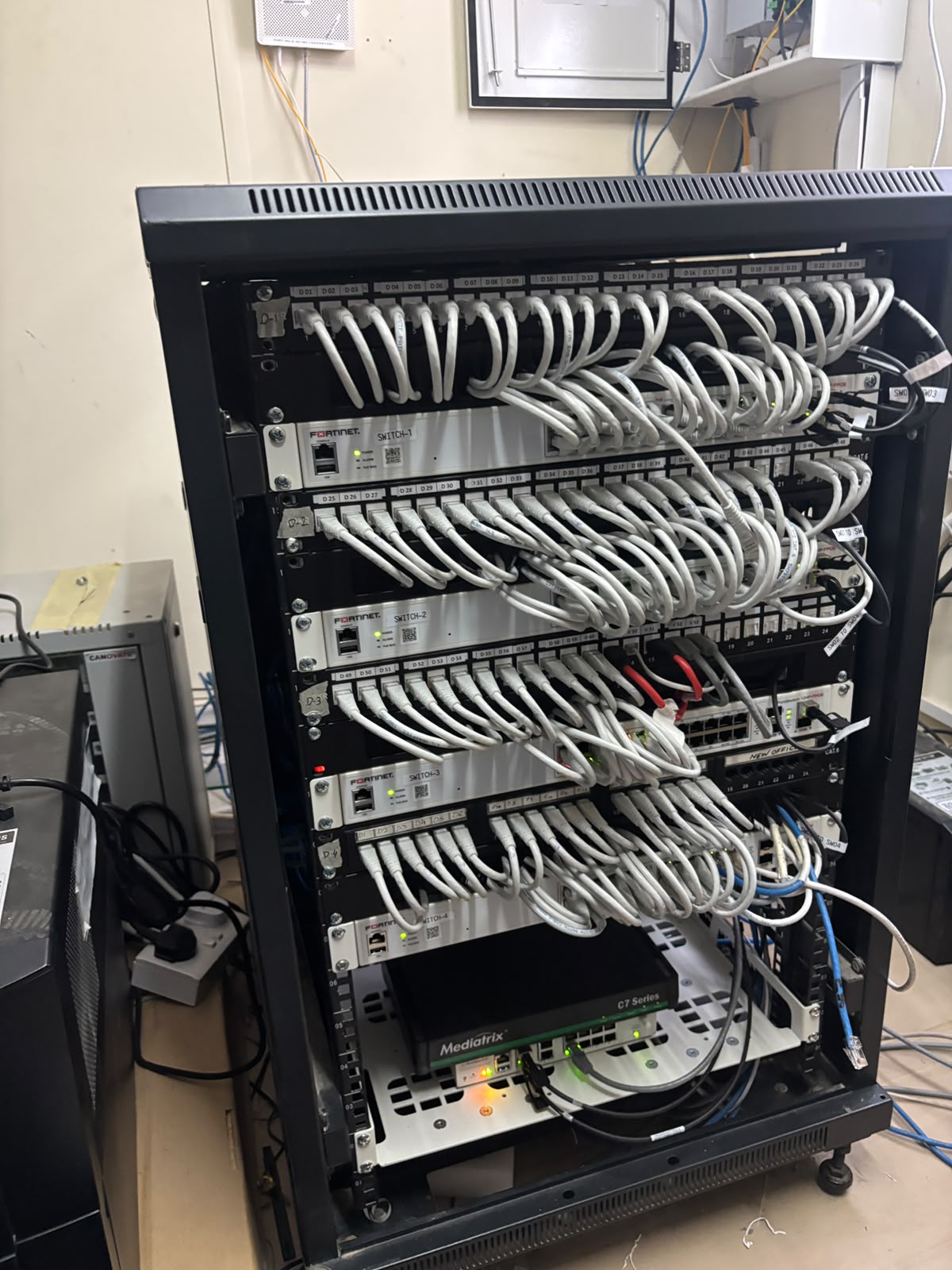 After
A structured, clearly organized cabinet where every network point and cable can be identified, ready for future expansion.
The Solution
CITS deployed a complete Fortinet-based network and brought every device under a single management platform. All five FortiSwitches and all five FortiAP access points were integrated with the FortiGate firewall through FortiLink, so the client can now manage the firewall, switching, and wireless infrastructure from one centralized interface. This simplifies network administration and improves visibility across the whole environment.
On the security side, the required firewall policies were configured and enabled on the FortiGate, and network zones were set up to control communication between the different network segments. This gives the client better control over internal, guest, wireless, and voice traffic, network access between segments, and internet connectivity.
The FortiGate was also connected to FortiAnalyzer Cloud, which provides centralized access to network logs, events, and monitoring information to support administration, troubleshooting, and security monitoring. All required licenses and service subscriptions, including Forti Elite Service, were activated and verified.
Deployed Infrastructure
Network Design & Segmentation
Network traffic was separated using dedicated VLANs, while wireless access was split between a corporate network and an isolated guest network. The result is improved traffic separation, security, and network administration that still supports the client’s operational requirements.
VLAN 70: User Network
Configured for the existing corporate user network and internal endpoint connectivity.
VLAN 50: AP Management
A dedicated management network for the FortiAP wireless access points.
VLAN 90: Voice Network
A dedicated network for voice communication and telephony services.
Guest Wi-Fi Isolation
A dedicated guest wireless network gives visitors secure internet access without exposing internal corporate resources. Guest traffic runs in FortiAP tunnel mode and stays separated from the internal networks, so guest users cannot directly reach internal services.
Wireless Access Points
Five FortiAP 231-K access points were installed, configured, and integrated with the FortiGate. Two SSIDs were created, a corporate network for employees and authorized users and a guest network for visitors, each with appropriate traffic separation and isolation. All access points were confirmed operational.
Scope of Work
The project covered the full path from physical preparation of the cabinet through configuration, validation, and final handover:
- Network cabinet reorganization
- Structured cable management and labeling
- FortiGate firewall installation and configuration
- FortiSwitch installation and configuration
- FortiAP installation and configuration
- FortiLink integration
- 10G inter-switch uplink configuration
- VLAN implementation
- Wireless SSID configuration
- Guest Wi-Fi isolation
- Firewall security policy configuration
- FortiAnalyzer Cloud integration
- Network performance optimization
- License activation and verification
- Testing and validation
- Final operational handover
Testing & Validation
Following implementation, the network infrastructure was tested and validated to ensure proper operation. The following areas were verified, and all major network components were confirmed operational:
Results
Key Outcomes
The project successfully addressed the major challenges identified in the client’s existing network environment.
Improved Network Organization
The network cabinet and cabling were reorganized, dressed, and labeled, significantly improving physical network management.
Centralized Management
All FortiSwitches and FortiAPs are centrally managed through the FortiGate using FortiLink, giving the client a single management platform for the primary Fortinet network infrastructure.
Enhanced Security
Network traffic is properly segmented and guest wireless traffic is securely isolated from internal networks, while firewall security policies give better control over network communication and internet access.
Improved Performance & Scalability
10G SFP+ uplinks provide a high-speed backbone and LAN connectivity has reached internet speeds of 800 Mbps and above, on an architecture that provides a strong foundation for future expansion.
Improved Monitoring
FortiAnalyzer Cloud provides centralized logging and network visibility, so the client can monitor network activity and security events more effectively.
Simplified Troubleshooting
Proper cable labeling, centralized device management, and improved network visibility make troubleshooting faster and more efficient.
Conclusion
The implementation transformed the existing network into a structured, centralized, secure, and high-performance infrastructure. Dedicated VLANs for user, access point management, and voice services improved segmentation and traffic control, while the isolated guest wireless network gives visitors secure connectivity without exposing internal resources. The 10G SFP+ inter-switch uplinks established a high-speed backbone, with LAN connectivity reaching internet speeds of 800 Mbps and above, and FortiAnalyzer Cloud now provides centralized logging and monitoring.
Together with the cabinet reorganization and structured cable management, the project has resolved the client’s key challenges around network organization, performance, security, centralized management, and monitoring. The network is now stable, secure, high-performing, centrally managed, easier to troubleshoot, and ready for production use, with a strong foundation for future growth.
Final Network Status
Let’s Discuss Your Requirements
Speak with our team about a similar network infrastructure deployment or optimization for your organisation.
Contact Us